In the rapidly evolving landscape of global finance and digital security, few developments have been as consequential—or as poorly understood by the general public—as the rise of cryptocurrency and the dark web. These twin phenomena have created new possibilities for both legitimate commerce and criminal enterprise, new vulnerabilities in the infrastructure of modern civilization, and new battlegrounds for the conflicts that will define the coming decades.
The best techno-thriller cryptocurrency fiction engages with these realities not as background color but as the central subject of the narrative. When done well, this genre offers readers something genuinely valuable: a way of understanding complex technological and financial systems through the lens of human drama, of grasping the implications of digital warfare through stories that make the abstract concrete and the technical personal.
Understanding the Threat Landscape
To appreciate the power of the best dark web thriller fiction, it helps to understand the actual threat landscape that these stories explore. Cryptocurrency, for all its legitimate uses, has also become the preferred financial instrument of criminal enterprises precisely because of the properties that make it attractive to legitimate users: its decentralization, its pseudonymity, and its resistance to censorship and seizure.
The dark web—the portion of the internet accessible only through specialized software like the Tor browser—provides the marketplace where these financial instruments are deployed. Drug trafficking, weapons sales, human trafficking, ransomware payments, and the trade in stolen financial data all flow through these channels, generating billions of dollars in illicit revenue annually.
But the most sophisticated threats are not criminal enterprises in the conventional sense. They are state-sponsored operations—intelligence agencies and military units using cryptocurrency and dark web infrastructure to fund covert operations, launder money, evade sanctions, and conduct financial warfare against adversaries. This is the territory that the best techno-thriller cryptocurrency fiction explores.
The Crypto Conspiracy: A Novel That Predicted Tomorrow’s Headlines
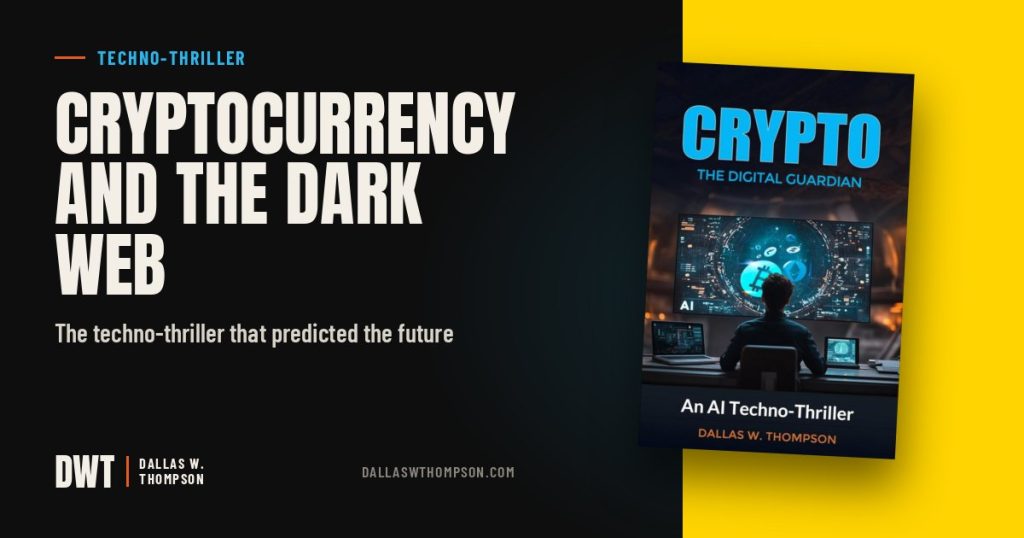
Dallas W. Thompson’s The Crypto Conspiracy: A Cryptocurrency Techno-Thriller is a remarkable achievement: a novel that reads not as fiction but as a warning, a detailed and technically credible account of how cryptocurrency and dark web infrastructure could be weaponized to destabilize the global financial system.
The novel’s premise is chillingly plausible: a sophisticated conspiracy uses cryptocurrency to fund a coordinated attack on the financial infrastructure of multiple nations, exploiting the vulnerabilities of a system that was designed for transparency and efficiency but never adequately secured against determined adversaries. The protagonists—a team of financial investigators and intelligence operatives—must navigate a labyrinth of digital obfuscation to identify and stop the conspirators before the damage becomes irreversible.
Thompson’s background in finance—he served as a staff accountant at Union Oil Company and built a multimillion-dollar business empire—gives him a perspective on the financial system that most thriller writers lack. He understands not just how money moves but how it can be hidden, how the seams and vulnerabilities of the financial system can be exploited by those with the knowledge and the will to do so.
Combined with his military cryptography background—Thompson served in the USAF Joint Chiefs of Staff Far East Crypto—this gives him a uniquely authoritative perspective on the intersection of finance and intelligence that is the heart of the novel.
Explore The Crypto Conspiracy at DallasWThompson.com
The Technical Authenticity of the Best Cyber Thrillers
What separates the best cyber thriller fiction from the merely competent is technical authenticity. Readers who work in finance, technology, or intelligence can immediately detect when an author is faking it—when the technical details are vague or wrong, when the systems described do not work the way the author claims, when the threats are exaggerated or misunderstood.
Thompson’s work passes this test with flying colors. The cryptocurrency mechanics in The Crypto Conspiracy are accurate; the dark web infrastructure is described with genuine knowledge; the financial systems under attack are real systems with real vulnerabilities. This authenticity is not merely a matter of credibility; it is what gives the novel its genuine sense of menace. The threat feels real because it is real—or could be, with only minor variations from the scenario Thompson describes.
Conclusion: Fiction as Warning
The best techno-thriller cryptocurrency fiction serves a purpose beyond entertainment. In a world where the threats it describes are real and growing, fiction that helps the general public understand these threats—that makes the abstract concrete, that gives human faces to the forces shaping our digital future—performs a genuine public service.
Thompson’s The Crypto Conspiracy is exactly this kind of fiction: a gripping, technically credible thriller that also serves as a warning about the vulnerabilities of our digital financial infrastructure. It is essential reading for anyone who wants to understand the world we are living in.
Explore Thompson’s complete bibliography at DallasWThompson.com.