What is reality? It is perhaps the oldest question in philosophy, and in the age of quantum mechanics, it has become more urgent and more mysterious than ever. The discoveries of twentieth-century physics have shattered the comfortable certainties of the Newtonian worldview, revealing a universe that is far stranger and far more intimately connected to the act of observation than anyone had previously imagined.
The Collapse of the Classical Worldview
For three centuries after Newton, the dominant picture of reality was mechanistic and deterministic. Quantum mechanics demolished this picture. The discovery that subatomic particles exist in superpositions of multiple states until they are observed—that the act of measurement appears to determine which of many possible outcomes becomes actual—introduced consciousness into the heart of physics in a way that the founders of the theory found deeply troubling and have never fully resolved.
The observer effect in quantum physics is not a peripheral curiosity; it is a central feature of the theory. And its implications for the philosophy of reality are staggering: if observation plays a role in determining physical outcomes, then the boundary between mind and world is not as sharp as we thought. The universe is not simply out there, waiting to be observed; it is, in some sense, brought into being by the act of observation.
The Observer-Reality Nexus: Thompson’s Philosophical Framework
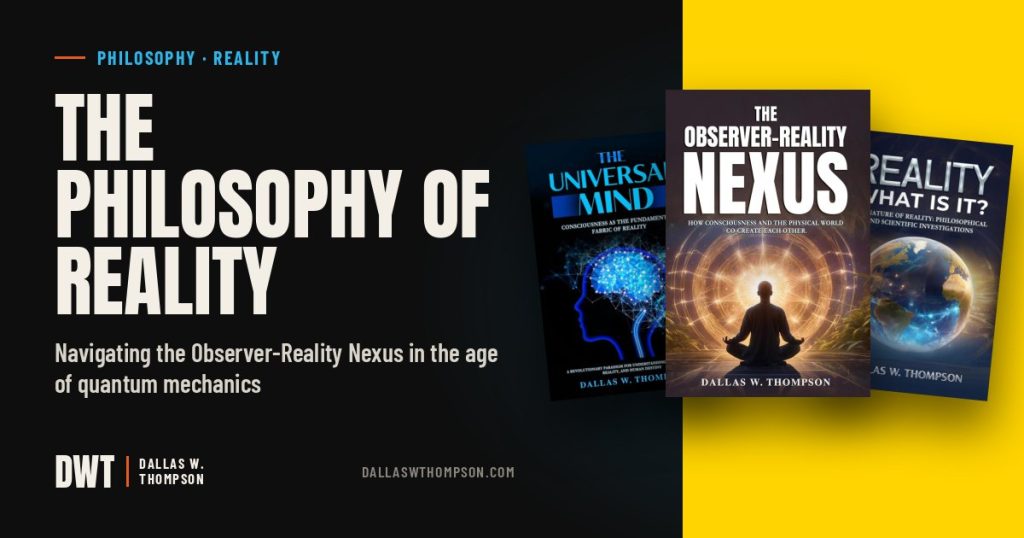
Dallas W. Thompson’s The Observer-Reality Nexus is the most comprehensive and intellectually rigorous treatment of these ideas available to the general reader. Drawing on quantum mechanics, philosophy of mind, and the wisdom traditions of both East and West, Thompson constructs a framework for understanding the relationship between consciousness and reality that is both scientifically grounded and philosophically sophisticated.
The central concept—the Observer-Reality Nexus—refers to the dynamic, bidirectional relationship between the observing mind and the observed world. Thompson argues that this relationship is not merely a feature of quantum mechanics at the subatomic scale; it is a fundamental feature of reality at every scale, from the quantum to the cosmic. This is a bold claim, supported with characteristic rigor and care through evidence from quantum mechanics, neuroscience, psychology, and the contemplative traditions.
Retrocausality and the Nature of Time
One of the most fascinating sections deals with retrocausality—the possibility that future events can influence past ones. This idea, which sounds like science fiction, is a serious proposal within quantum mechanics, supported by experimental evidence and endorsed by respected physicists including John Wheeler and Yakir Aharonov. Thompson’s treatment of retrocausality explained for the general reader is a model of clarity and intellectual honesty—accessible yet genuinely illuminating.
The implications for the philosophy of reality are profound. If the future can influence the past, then our conventional picture of time as a one-way flow is incomplete. The universe may be more like a four-dimensional block in which past, present, and future all exist simultaneously, with causal influences flowing in both temporal directions.
The Universal Mind: Consciousness as the Fabric of Reality
Thompson’s proposed solution to the Hard Problem of Consciousness draws on the concept of the universal mind—the idea that consciousness is not produced by the brain but is a fundamental feature of reality, of which individual minds are local expressions. This carefully developed form of panpsychism engages seriously with objections and develops a nuanced position that deserves serious consideration from anyone interested in philosophy of mind books.
Conclusion
The philosophy of reality in the quantum age is not a luxury; it is a necessity. The Observer-Reality Nexus by Dallas W. Thompson is one of the most important books you will read this year. Explore it and Thompson’s complete bibliography at DallasWThompson.com.