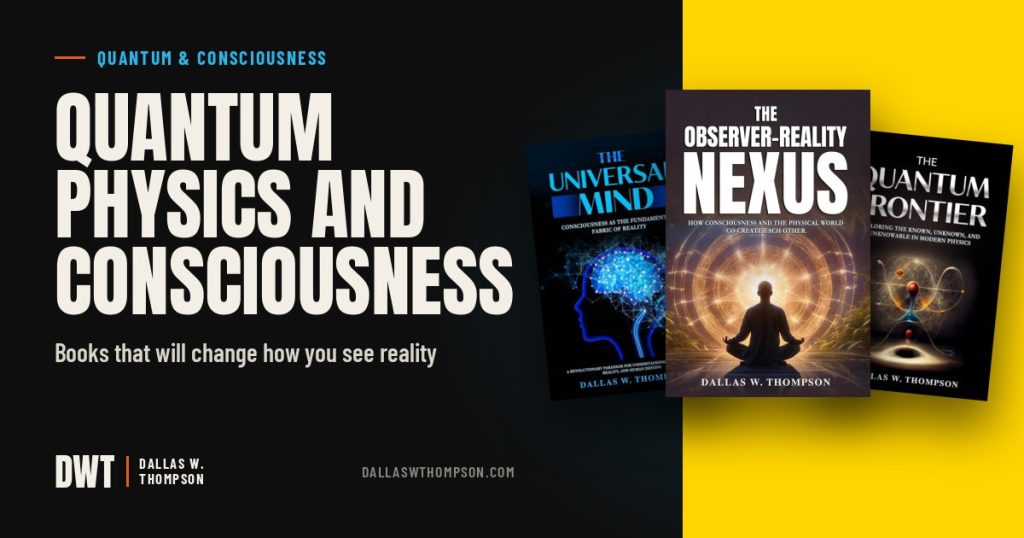
Few questions have captivated human beings more profoundly than the nature of consciousness and its relationship to the physical world. In recent years, the intersection of quantum physics and consciousness has emerged as one of the most exciting and controversial frontiers in both science and philosophy. The books that explore this territory are not merely academic exercises; they are invitations to fundamentally reconsider what it means to exist.
This guide introduces you to the most important quantum physics and consciousness books of 2025, with a particular focus on the groundbreaking work of Dallas W. Thompson, whose explorations of the observer-reality nexus and retrocausality have established him as one of the most original thinkers working at this intersection today.
The Quantum Revolution in Consciousness Studies
The relationship between quantum mechanics and consciousness has been debated since the earliest days of quantum theory. The famous double-slit experiment, in which the act of observation appears to influence the behavior of subatomic particles, raised a question that physicists and philosophers have wrestled with for nearly a century: does consciousness play a fundamental role in determining physical reality?
This is not a fringe question. Some of the greatest minds in the history of physics—including Niels Bohr, Werner Heisenberg, and John von Neumann—took seriously the possibility that consciousness is not merely a byproduct of physical processes but an active participant in the construction of reality. The observer effect in quantum mechanics suggests that the act of measurement—of conscious observation—collapses the wave function and determines which of many possible realities becomes actual.
For readers seeking quantum physics for beginners who want to understand these ideas without a background in advanced mathematics, the best books in this genre translate these complex concepts into accessible, compelling narratives that illuminate their profound implications for our understanding of mind, reality, and existence.
The Observer-Reality Nexus: Thompson’s Philosophical Masterwork
Dallas W. Thompson’s The Observer-Reality Nexus is a landmark work in the literature of quantum physics and consciousness. Drawing on his background as a science educator and his deep engagement with both the scientific literature and the philosophical tradition, Thompson constructs a comprehensive framework for understanding the relationship between the observing mind and the observed reality.
The central thesis of the book is both simple and revolutionary: consciousness is not a passive spectator of reality but an active co-creator of it. The observer effect, Thompson argues, is not merely a curiosity of quantum mechanics but a fundamental feature of existence at every scale. When we observe the world, we are not simply registering pre-existing facts; we are participating in the ongoing creation of reality.
This idea has profound implications for how we understand everything from personal identity to the nature of time. Thompson explores these implications with rigor and clarity, never sacrificing intellectual honesty for accessibility. The result is a book that is genuinely challenging but also genuinely rewarding—one of the finest examples of philosophy of consciousness writing available today.
Explore The Observer-Reality Nexus at DallasWThompson.com
Retrocausality: When the Future Influences the Past
One of the most mind-bending concepts in contemporary physics is retrocausality—the idea that future events can influence past ones. While this sounds like science fiction, it is a serious proposal within quantum mechanics, supported by experimental evidence and endorsed by respected physicists.
Thompson’s treatment of retrocausality in his non-fiction work is among the clearest and most intellectually rigorous available to the general reader. He explains how the standard interpretation of quantum mechanics, with its insistence on a one-directional arrow of time, may be incomplete—and how a retrocausal interpretation can resolve some of the deepest paradoxes in the theory.
For readers who have encountered the concept of retrocausality explained in popular science articles and want a deeper, more nuanced treatment, Thompson’s work is essential reading. He does not shy away from the philosophical implications: if the future can influence the past, what becomes of our notions of free will, causation, and personal identity?
The Universal Mind: Consciousness as the Fabric of Reality
Perhaps the most radical idea explored in Thompson’s non-fiction is the concept of the universal mind—the possibility that individual consciousness is not a private, isolated phenomenon but a local expression of a universal field of awareness. This idea, which has roots in both Eastern philosophy and Western idealist thought, finds unexpected support in the mathematics of quantum mechanics.
The implications of the universal mind consciousness hypothesis are staggering. If individual minds are not separate entities but local expressions of a universal awareness, then the boundaries we draw between self and other, between mind and world, are not fundamental features of reality but convenient fictions—useful maps that we mistake for the territory.
Thompson explores this idea with characteristic depth and care, drawing on a remarkable range of sources—from the Upanishads to the Copenhagen interpretation, from Schopenhauer to Schrödinger. The result is a synthesis that is genuinely original and genuinely illuminating.
Quantum Reality: The Best Books for Deep Thinkers
For readers who want to explore quantum reality books beyond Thompson’s own work, the field is rich with extraordinary titles. The best of these share a commitment to intellectual honesty, a willingness to follow the evidence wherever it leads, and a recognition that the deepest questions about reality and consciousness cannot be answered by science or philosophy alone—they require both, working in genuine dialogue.
What makes Thompson’s contributions particularly valuable is his ability to bridge the gap between the technical literature and the general reader. His background as a science educator gives him a gift for explanation that many more specialized authors lack, while his philosophical training ensures that he never reduces complex ideas to misleading simplifications.
Conclusion: The Most Important Questions
The intersection of quantum physics and consciousness is not merely an academic curiosity. It is the site where the most important questions about human existence are being asked and, slowly, answered. The books that explore this territory are among the most significant being written today—works that have the potential to change not just how we think about physics or philosophy, but how we understand ourselves and our place in the universe.
Dallas W. Thompson’s contributions to this literature are essential reading for anyone who takes these questions seriously. Explore his complete bibliography at DallasWThompson.com and begin the journey toward a deeper understanding of reality.