A career change later in life is rarely a single decision. More often, it begins as a persistent question: what else could I build, contribute, or become? That question can arrive after success, after disappointment, after retirement, or after an unexpected disruption. It can be energizing and frightening at the same time.
Reinvention is not a rejection of everything that came before. The strongest career changes use earlier experience as material. Skills, discipline, relationships, failures, technical knowledge, and hard-won perspective do not disappear when a person changes direction. They become the foundation for the next chapter.
Stop Waiting for a Perfect Moment
Many people postpone a career change because they imagine that confidence must come first. In reality, confidence usually follows action. You learn what the next path requires by taking a small step: completing a course, interviewing someone in the field, building a sample project, joining a professional group, or setting aside a fixed hour each week for deliberate work.
A perfect time may never appear. Financial obligations, family responsibilities, health, and uncertainty are real. The answer is not to ignore them. It is to build a plan that respects them. A gradual transition may be wiser than an abrupt leap, especially when a new field requires training, portfolio work, or an entirely different professional network.
Turn Your Past Into an Advantage
Career changers often focus on what they lack. They may say, “I do not have a degree in this field,” or “I have not done this job before.” Those concerns can be valid, but they are not the whole picture. The more useful question is: what evidence do I already have that I can solve problems, learn quickly, lead, communicate, persist, or deliver results?
Transferable skills cross job titles. A teacher may bring clarity, organization, and audience awareness to corporate training. A contractor may bring project management, risk assessment, and customer communication to operations. A service member may bring discipline, teamwork, technical experience, and calm under pressure. An entrepreneur may bring resilience and an instinct for opportunity.
Write those abilities down in plain language. Then connect each one to the new field. This exercise can improve a résumé, a professional biography, and—most importantly—your understanding of your own value.
Learn Publicly and Build Evidence
When changing careers, credentials can help, but visible evidence often matters just as much. Create a portfolio, publish a useful article, complete a case study, volunteer for a limited project, or build a demonstration that shows how you think. Evidence turns an aspiration into something another person can evaluate.
For a writer, that evidence may be a body of work. For a consultant, it may be a practical framework. For a designer, it may be a collection of finished projects. For someone moving into a technical role, it may be documentation, a small application, an analysis, or a certification paired with hands-on work.
Do not wait until the work is flawless before showing it. Share it when it is accurate, useful, and representative of the standard you want to maintain. Feedback is part of the transition, not a sign that you began too early.
Choose a Direction, Then Test It
“I want a new career” is too broad to guide action. Define a direction narrowly enough that you can test it. Instead of deciding that you want to “work in technology,” you might explore technical writing, cybersecurity awareness training, customer support, data analysis, or web content management. Instead of deciding that you want to “be creative,” you might test writing, editing, instructional design, photography, or community programming.
A test is smaller than a permanent commitment. Take a course. Shadow someone. Complete a real assignment. Talk to people who do the work every day. Notice what you enjoy, what drains you, which skills come naturally, and which skills you are willing to develop.
Testing does not waste time. It prevents you from making a major decision based only on an imagined version of the work.
Use Structure Instead of Motivation Alone
Motivation changes from week to week. Structure is more dependable. Set a schedule that fits your real life, not an idealized one. A person with a demanding job may have three focused hours each week. A person in transition may have more. What matters is consistency.
Break the change into visible milestones: research the field, identify the core skills, complete one course, produce one work sample, contact five people, apply to a defined number of opportunities, and review progress at the end of each month. Small completed steps build momentum. Vague intentions do not.
Keep a record of what you learn. A weekly note can reveal progress that is easy to overlook day by day. It also helps you adjust the plan when an assumption turns out to be wrong.
Build Relationships Before You Need Them
Career transitions are easier when they are not solitary. Reach out with respect and curiosity. Ask people about the realities of their work, the skills they use most, the problems they wish newcomers understood, and the paths that brought them into the field. Do not begin every conversation by asking for a job. Begin by learning.
Relationships grow through reliability. Follow through when you say you will. Thank people for their time. Share useful information when you can. Keep in touch without demanding constant attention. Over time, a genuine professional network becomes a source of perspective, opportunity, and accountability.
Reinvention Can Happen More Than Once
The idea of one true calling is comforting, but many lives are more varied than a single-lane story. A person may serve in one field, build a business in another, teach in a third, and create art or write books later on. Those shifts do not invalidate earlier work. They show that a career can be a sequence of meaningful chapters.
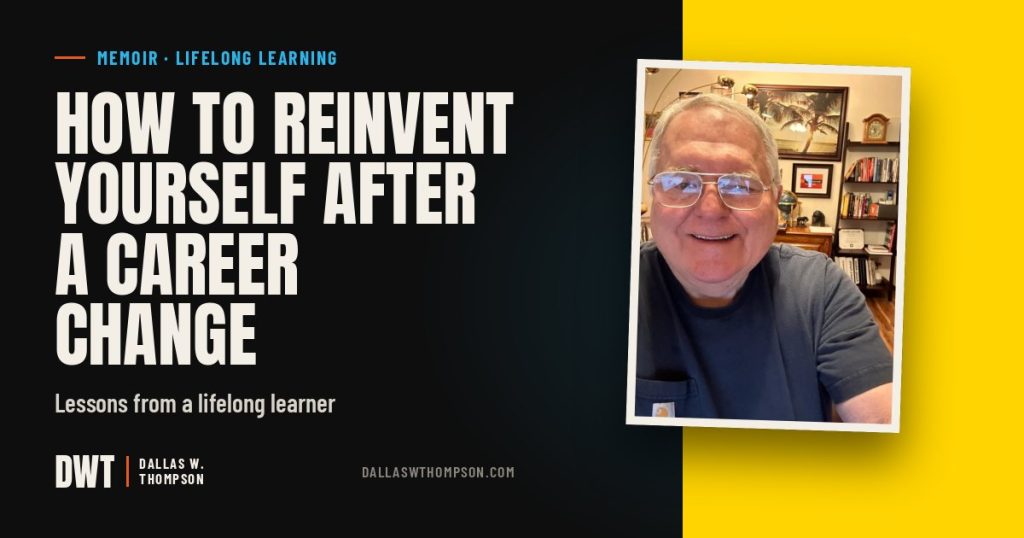
Dallas W. Thompson’s professional life has included service, accounting, entrepreneurship, construction, education, administration, and authorship. That range is a reminder that reinvention does not require pretending to be someone else. It requires learning, building, and carrying forward the parts of your experience that remain useful.
Start With One Honest Step
You do not need a ten-year master plan to begin. You need one next action that is specific enough to complete. Research a role. Make a list of transferable skills. Sign up for a course. Draft a portfolio page. Write the first page. Contact one person whose work you respect.
A career change later in life may be challenging, but it also offers an advantage: perspective. You know more about the kinds of problems you can tolerate, the environments where you do your best work, and the values you want your next chapter to reflect. Use that knowledge. It may be the most valuable qualification you have.
For more of Dallas W. Thompson’s work and author background, visit the Books page and the About the Author page.